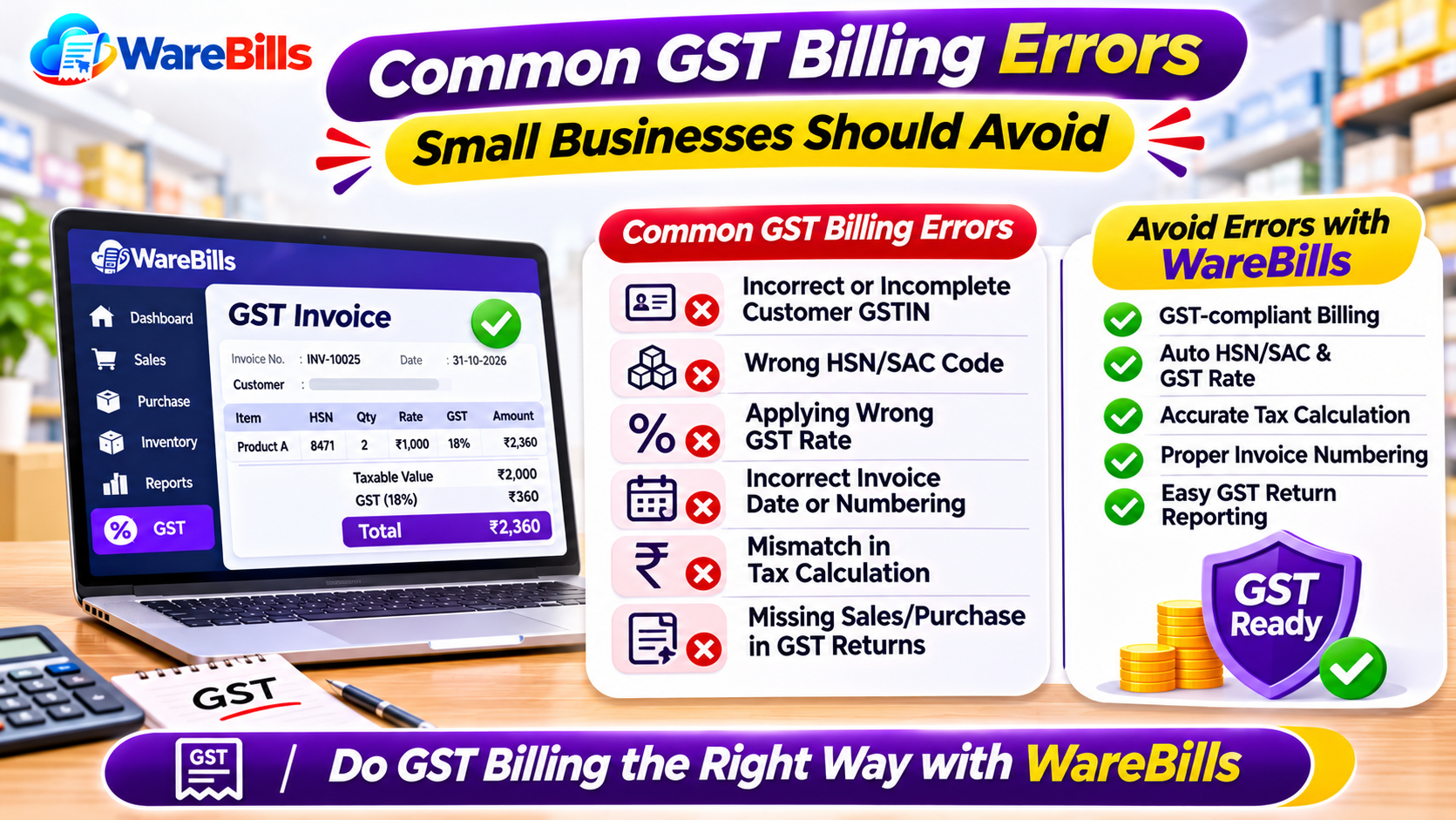
Even small mistakes—such as an incorrect GSTIN, an unsuitable tax rate or a mismatch between taxable value and invoice total—can create reconciliation problems, require corrections and consume valuable time.
A consistent invoice verification process helps businesses reduce avoidable errors and maintain better billing records.
1. Entering an Incorrect GSTIN
A GST Identification Number (GSTIN) identifies a registered taxpayer. Entering an incorrect GSTIN for the supplier or recipient can create problems when invoices are checked or reconciled.
How to avoid this error:
- Verify the supplier's GSTIN against reliable business records.
- Check the customer's GSTIN where applicable.
- Maintain accurate customer and supplier master data.
- Review GSTIN changes before updating saved records.
Do not assume that a GSTIN is valid merely because it has the expected number of characters. Verify the details using the official GST portal when necessary.
2. Applying the Wrong GST Rate
Different goods and services may attract different GST treatments. Applying an incorrect rate can lead to an inaccurate tax amount and an incorrect invoice total.
For example, a business might accidentally apply the rate used for one product to another product with a different classification.
Prevention tips:
- Maintain the correct product or service description.
- Verify the applicable HSN or SAC classification where required.
- Check the current applicable GST rate using official GST resources.
- Review tax settings when adding or updating products.
- Recheck unusual rates before issuing an invoice.
Do not select a tax rate based only on a similar product or an old invoice. Confirm the applicable treatment for the specific supply.
3. Confusing CGST/SGST with IGST
The applicable tax structure generally depends on whether a supply is intra-State or inter-State under GST rules.
For many taxable supplies within the same State, CGST and SGST apply. For qualifying inter-State supplies, IGST generally applies. Special rules and exceptions may apply depending on the transaction.
How to reduce errors:
- Verify the supplier's location and the place of supply.
- Check the customer's details and transaction type.
- Configure billing software according to the applicable tax rules.
- Review the tax breakup before finalising the invoice.
For example, a transaction between parties in different States may require IGST rather than a CGST and SGST split, subject to the applicable place-of-supply rules.
4. Missing Required Invoice Details
An invoice may be incomplete if important details are missing or incorrect. The exact requirements depend on the type of supply and applicable GST rules.
A practical verification checklist includes:
- Supplier's name, address and GSTIN, where applicable.
- A unique invoice number and invoice date.
- Recipient details, including GSTIN or other required information where applicable.
- Product or service description.
- Quantity and unit details, where relevant.
- Taxable value and applicable tax rates.
- GST tax amounts and invoice total.
- HSN or SAC details where required.
- Place of supply and other prescribed particulars, where applicable.
Use the current GST invoice requirements relevant to your business. Not every field has identical requirements for every transaction type.
5. Making Errors in Taxable Value and Tax Calculations
An invoice can show the wrong total when discounts, additional charges, taxable values or tax amounts are calculated incorrectly.
Common causes include:
- Applying tax to the wrong value.
- Incorrectly handling discounts.
- Entering the wrong quantity or selling price.
- Calculating tax twice or omitting it.
- Rounding errors.
- Incorrectly adding line-item totals.
Example:
Suppose a taxable product value is ₹1,000 and the applicable GST rate is 18%.
- Taxable value: ₹1,000
- GST at 18%: ₹180
- Total: ₹1,180
This is a simplified example that assumes the entire ₹1,000 is taxable at 18%, with no additional charges or adjustments.
Before issuing an invoice, verify the quantity, unit price, taxable value, tax amount and final total.
6. Recording Discounts Incorrectly
Discounts can affect the taxable value depending on the applicable GST provisions and the circumstances in which the discount is offered.
A common mistake is to apply a discount in the billing calculation without checking how it should be reflected in the invoice and tax computation.
To reduce errors:
- Clearly record the discount and its basis.
- Check whether the discount qualifies for the relevant GST treatment.
- Verify the taxable value after the permitted adjustment.
- Ensure the invoice total matches the calculation.
- Seek professional guidance for complex post-supply discounts or credit-note situations.
Avoid assuming that every discount automatically reduces the taxable value for GST purposes.
7. Using the Wrong Invoice Type or Document
Businesses may need different documents depending on the transaction, registration status and applicable rules. Examples include tax invoices, bills of supply, credit notes and debit notes.
Using the wrong document can create confusion in accounting and tax records.
Before preparing a document, check:
- Whether the business is required to issue a tax invoice or another document.
- Whether the transaction involves a return, correction or price adjustment.
- Whether a credit note or debit note is appropriate.
- Whether the document meets the applicable requirements.
For unusual transactions, confirm the correct document type with a qualified tax professional.
8. Not Reviewing Sales Returns and Credit Notes
Returns, cancelled transactions and price adjustments must be reflected accurately in business records. If the original invoice and subsequent adjustment are not linked properly, sales and tax records may become inconsistent.
Good practices include:
- Recording the reason for a return or adjustment.
- Linking the adjustment to the original invoice where appropriate.
- Checking the quantity and value involved.
- Updating inventory records when goods are returned.
- Ensuring the corresponding accounting and GST treatment is correct.
The document and reporting treatment depends on the specific transaction and applicable rules.
9. Ignoring Invoice Sequence and Duplicate Numbers
Incorrect invoice numbering can complicate record-keeping and reconciliation. Duplicate numbers, missing records and inconsistent numbering practices should be investigated promptly.
Businesses should establish a consistent invoice-numbering process that meets applicable GST requirements.
Before issuing an invoice, check that:
- The invoice number follows the configured sequence.
- A number has not been reused accidentally.
- Cancelled invoices are documented appropriately.
- Records are preserved for future reference.
Use software controls where available, but periodically review the actual records rather than relying only on automated numbering.
10. Use a Pre-Invoice GST Verification Checklist
A short review before issuing an invoice can prevent many common mistakes.
Before finalising the invoice, verify:
- Supplier and recipient details.
- GSTINs, where applicable.
- Invoice number and date.
- Product or service description and classification.
- Quantity, price and taxable value.
- Applicable GST rate and tax structure.
- Discounts and additional charges.
- Invoice total and rounding.
- Required invoice particulars.
- Correct handling of returns, credit notes or other adjustments.
For complicated transactions or uncertain tax treatment, consult a qualified tax professional.
How Billing Software Can Help Reduce GST Invoice Errors
Billing software can reduce repetitive manual calculations and help businesses maintain consistent invoice records. Depending on the solution and its configuration, it may also support reusable product details, customer records, tax calculations and invoice reports.
However, software cannot guarantee tax compliance if product classifications, tax rates or transaction details are incorrect. Businesses must keep their settings updated and verify the applicable GST requirements.
Businesses considering WareBills can review its available billing and reporting features to determine whether they meet their invoicing workflow requirements. Confirm the specific GST functions needed before implementation.
Conclusion
GST invoice accuracy depends on correct business details, appropriate tax treatment, reliable calculations and complete records. Small businesses can reduce billing errors by maintaining accurate master data, reviewing tax settings and checking invoices before issuing them.
A consistent verification checklist, supported by suitable billing software and professional advice when needed, can help businesses maintain more reliable invoicing and accounting records.